Our case for review first
On November 2, Keep Cheney Green presented to Organized Neighbors of Summerhill (ONS). It's the first time we've laid out our full case in one place: what the Track Club's proposal contains, how it compares with the way APS has handled its other recent leases, and why the neighborhood should see the full proposal before any Board vote. It includes the results of our neighborhood survey. ONS's president refused to put our motion to a vote, saying ONS doesn't take positions on matters like this.
The short version: the only agreement is a non-binding letter of intent. The terms that protect the Track Club are specific. The terms that protect APS and the public are still to be agreed. APS's other recent leases went to the Board as final leases, with an appraisal. Cheney has never been appraised.
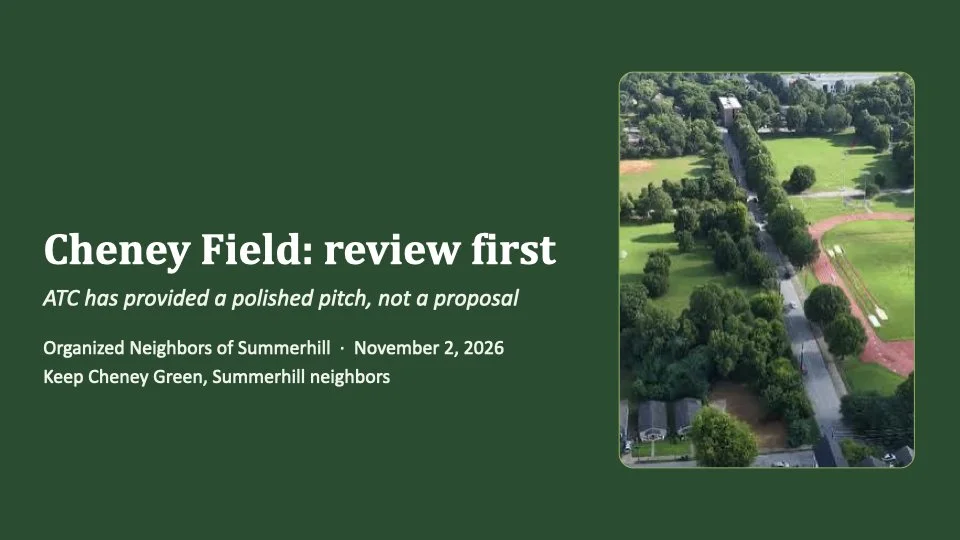
1. Cheney Field: review first. Keep Cheney Green presented this to Organized Neighbors of Summerhill on November 2, 2026. We're Summerhill neighbors who care about the future of our public greenspace. So far the Track Club has given us a polished pitch, not a proposal.
2. What we shared. Five things: what the Track Club's proposal for Cheney Field contains, how it compares with the way APS has handled its other recent leases, flooding here and downstream, a snapshot of neighbors' views from our survey, and one step ONS can take. We didn't ask ONS to take a side on the building. We asked that the neighborhood see the full proposal, and that the flooding questions be answered, before any Board vote.
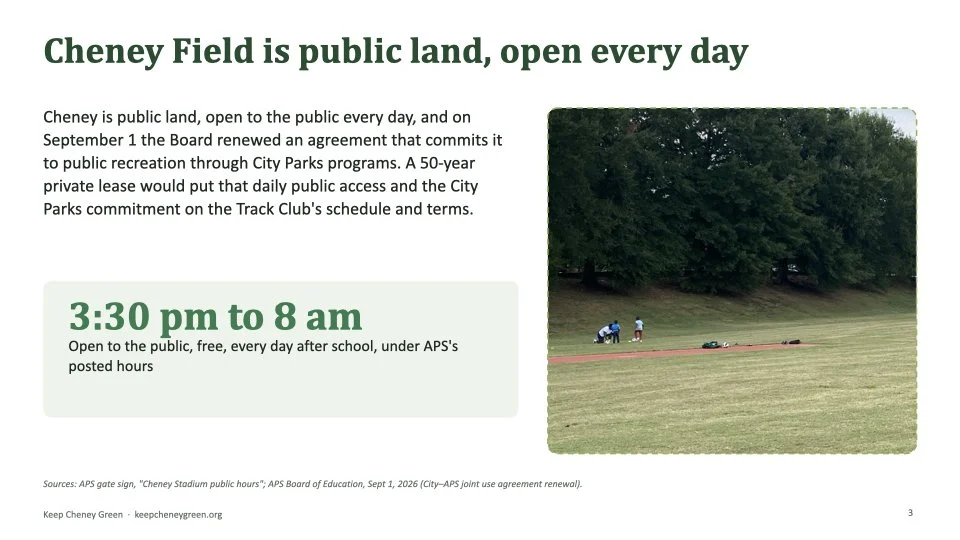
3. Cheney Field is public land, open every day. Cheney is public land, open to the public free every day after school, 3:30 pm to 8 am, and on September 1 the Board renewed the City–APS agreement that lists it for City Parks programs. A 50-year private lease would put that daily public access and the City Parks commitment on the Track Club's schedule and terms.
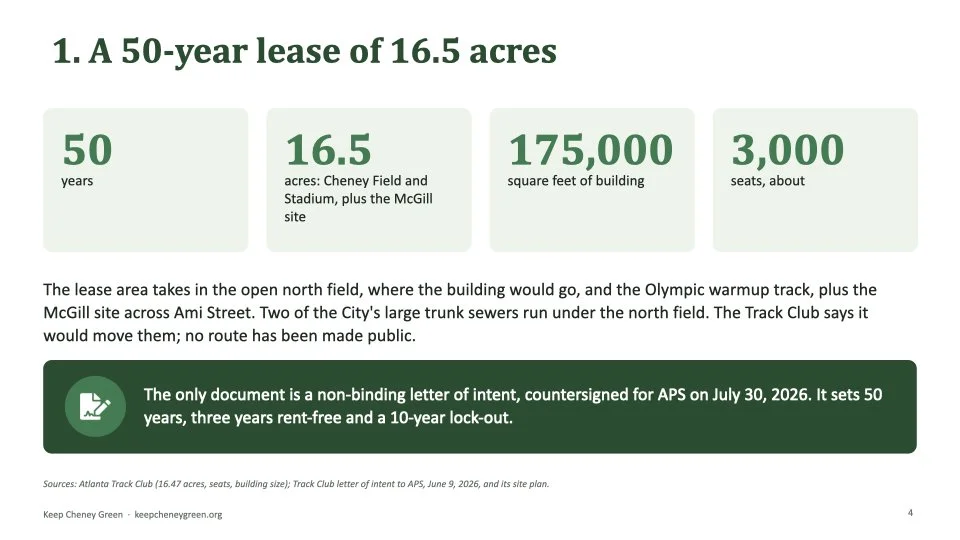
4. A 50-year lease of 16.5 acres. The only agreement is a non-binding letter of intent, countersigned for APS on July 30, 2026. It sets 50 years, three years rent-free and a ten-year lock-out before APS can take the land back for schools. The lease area takes in the open north field, where the building would go, the Olympic warmup track, and the McGill site across Ami Street. Two of the City's large trunk sewers run under the north field.
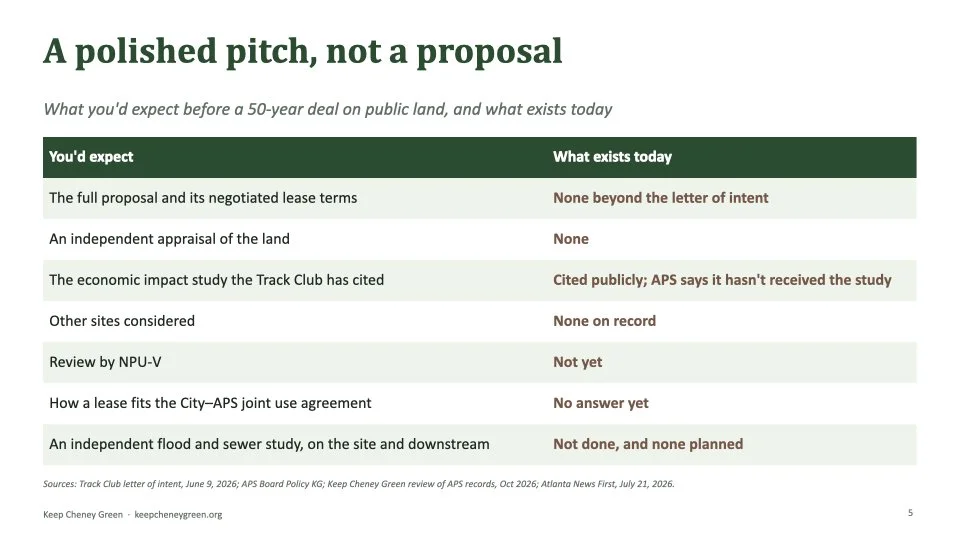
5. A polished pitch, not a proposal. This is the minimum the Board should have before it votes, and what existed on November 2. In July the Track Club told the press a study showed $70 to $80 million in economic impact; APS told us in October it hadn't been given the study. Since then the Track Club has published its November community report, which gives the study's totals but not the study.
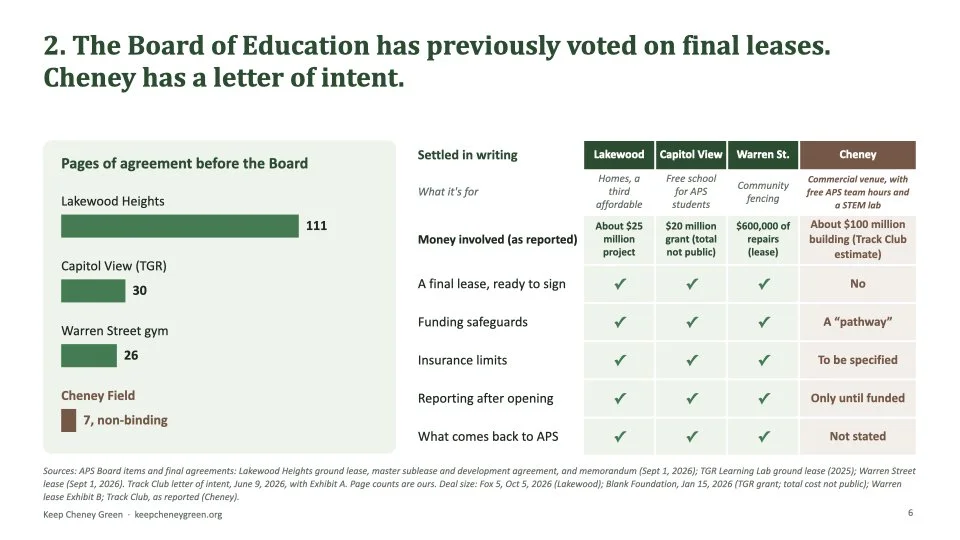
6. The Board has voted on final leases. Cheney has a letter of intent. Before its other lease votes, the Board had final agreements, each for a public purpose. Each one settles four things the Cheney letter leaves open: money (the letter asks only for a "pathway" to $65 million within a year of signing), insurance ("to be specified"), reporting (quarterly fundraising updates until it's funded, nothing after it opens), and what comes back to APS after 50 years (not stated). APS told us in October that the letter of intent is all it has. Cheney, at about $100 million by the Track Club's estimate, would be the biggest of the four, with the least in writing.
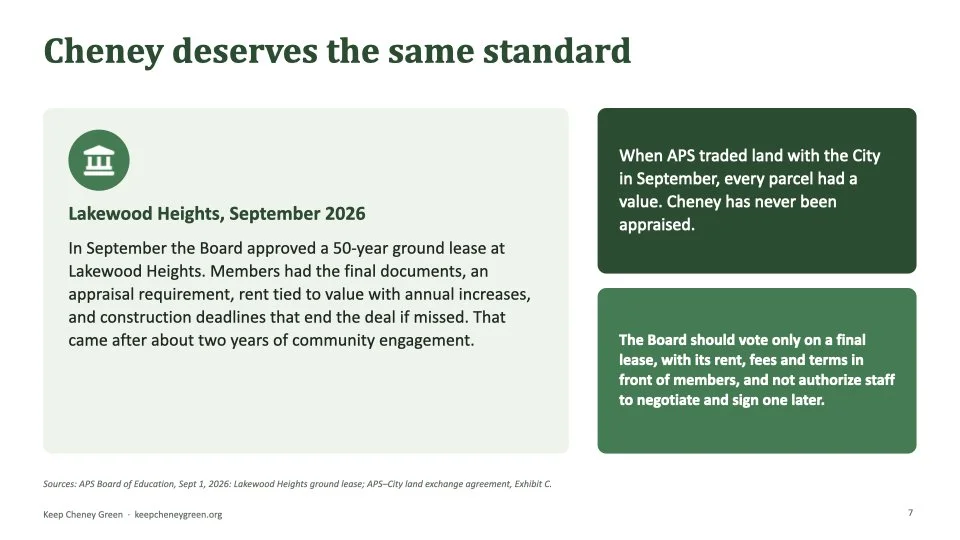
7. Cheney deserves the same standard. In September the Board approved a 50-year ground lease at Lakewood Heights. Members had the final documents, an appraisal requirement, rent tied to value with annual increases, and construction deadlines that end the deal if missed. That came after about two years of community engagement. When APS traded land with the City in September, every parcel had a value. Cheney has never been appraised.
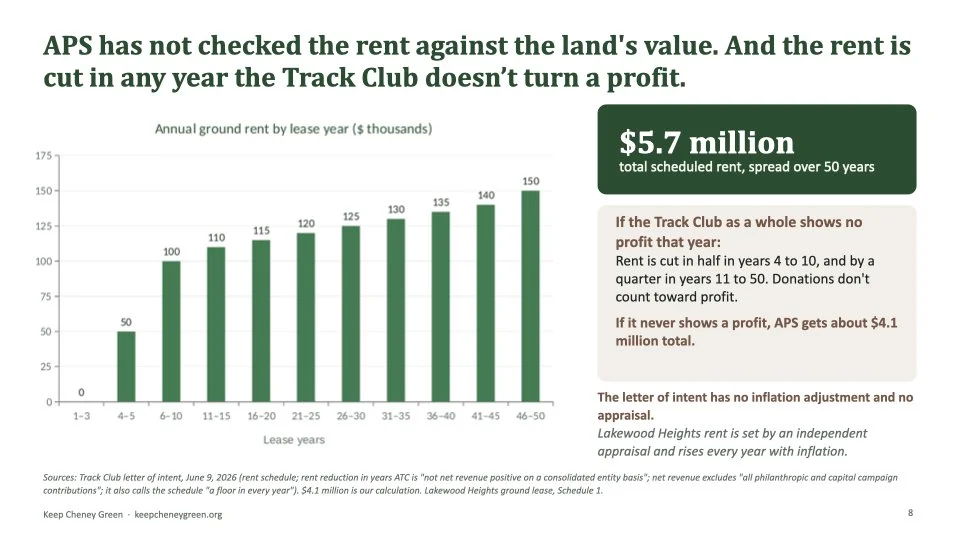
8. The rent has never been checked against the land's value. There is no appraisal. The rent is fixed at about $5.7 million over 50 years, with no inflation adjustment. In any year the Track Club as a whole doesn't turn a profit, leaving out donations, the rent is cut: by half in years 4 to 10, by a quarter after that. If it never shows a profit, APS would get about $4.1 million, by our calculation.
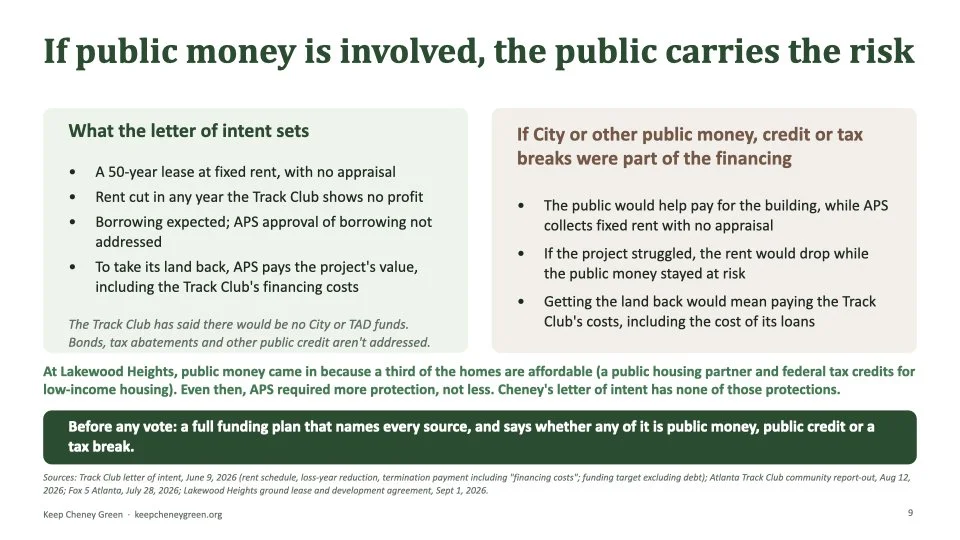
9. If public money is involved, the public carries the risk. The Track Club has said the building would be paid for through donations, tax credits and corporate partnerships, and "no City or TAD funds." It hasn't said whether bonds, tax breaks or other public credit are involved. If any of it is public, the public carries the risk on a building that pays fixed rent, and APS would have to pay the Track Club's financing costs to get its own land back. Before any vote, neighbors should see every funding source.
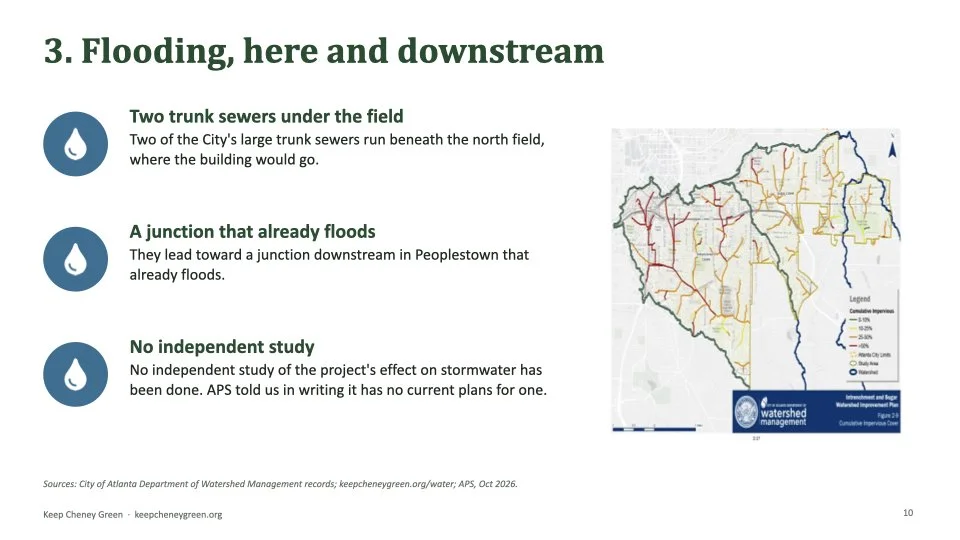
10. Flooding, here and downstream. Two of the City's trunk sewers run beneath the north field, where the building would go. They lead toward a junction downstream in Peoplestown that already floods. No independent study of the project's effect on stormwater has been done, and APS told us in writing it has no current plans for one.
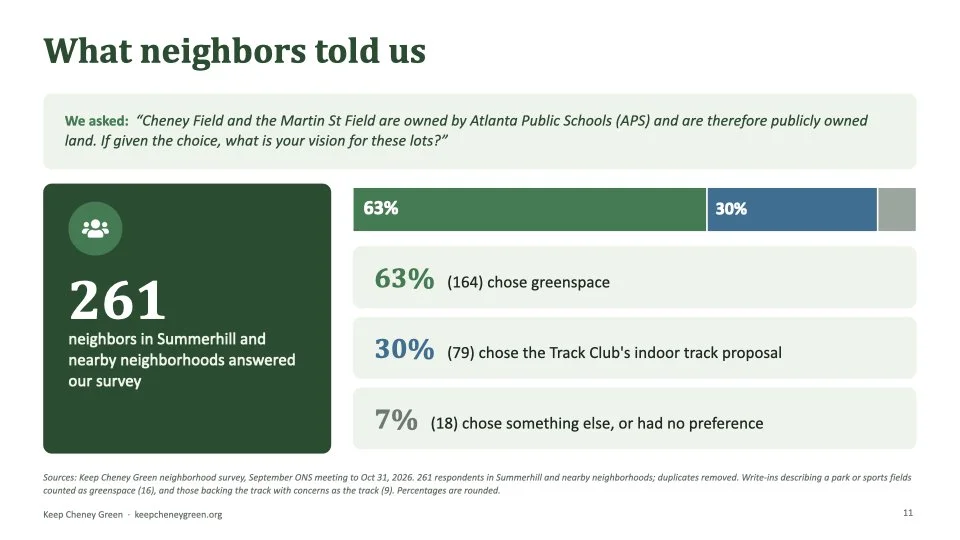
11. What neighbors told us. We asked one question: what is your vision for Cheney Field and the Martin Street field, which APS owns? The survey ran from the September ONS meeting through October 31, anonymous and open to every view, with duplicates removed. 261 neighbors in Summerhill and nearby neighborhoods answered. 63% chose greenspace and 30% chose the Track Club's indoor track.
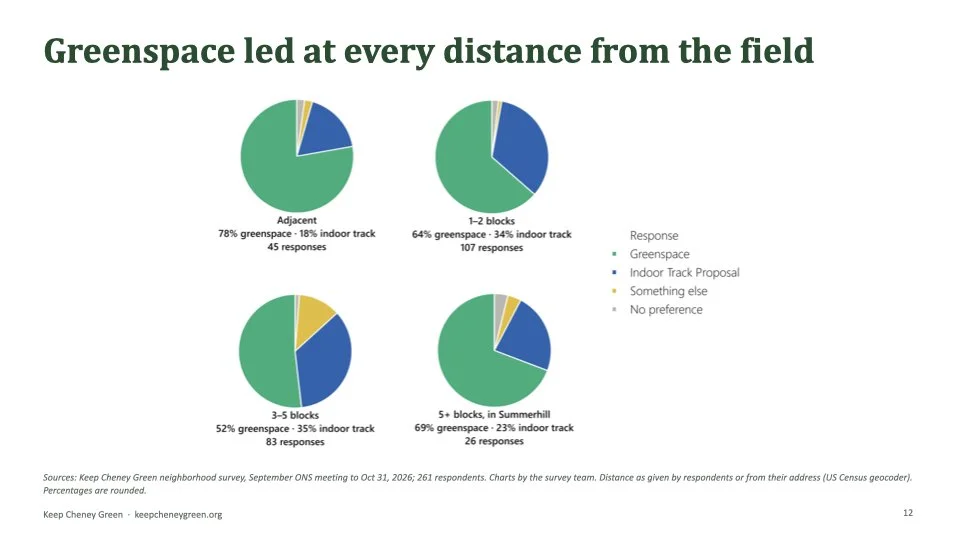
12. Greenspace led at every distance from the field. Right next to the field, 78% chose greenspace. Many people we talked to on the streets next to the field still didn't know about the proposal. Whichever side you're on, everyone deserves to see the full proposal before APS decides.
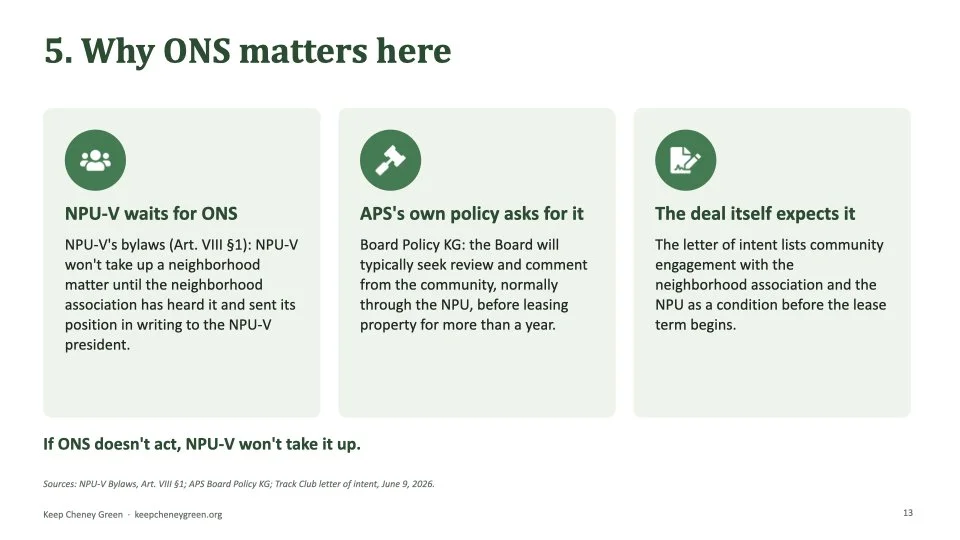
13. Why ONS matters here. NPU-V's bylaws say NPU-V won't take up a neighborhood matter until the neighborhood association has heard it and sent its position in writing. APS's lease policy says the Board will typically seek the community's review, normally through the NPU, before leasing property for more than a year. And the letter of intent itself lists engagement with the neighborhood association and the NPU as a condition. ONS is part of the process the deal itself expects.
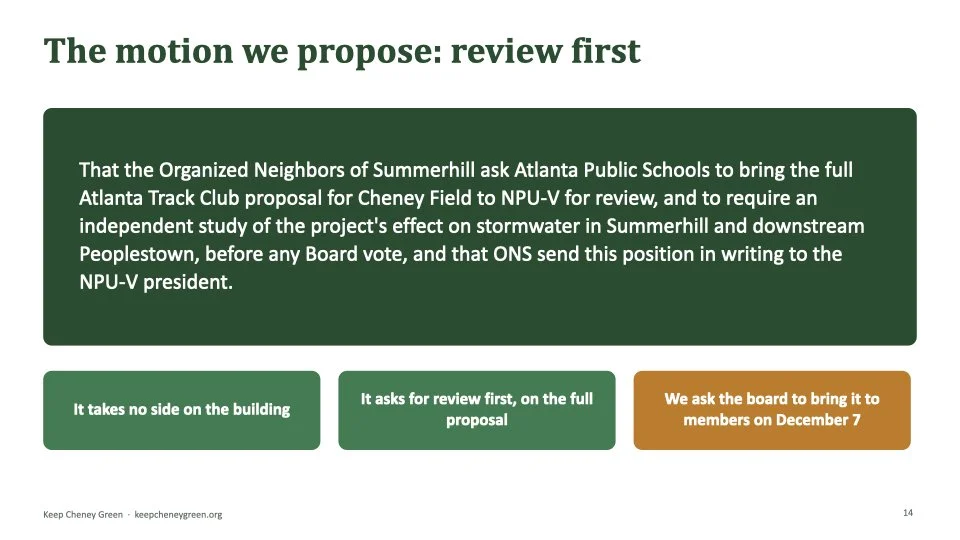
14. The motion. That ONS ask APS to bring the full Track Club proposal to NPU-V for review, and to require an independent study of the project's effect on stormwater in Summerhill and downstream Peoplestown, before any Board vote, and that ONS send this position in writing to the NPU-V president. It takes no side on the building. ONS's president refused to put our motion to a vote, saying ONS doesn't take positions on matters like this. Under ONS's bylaws, any member can ask in writing to put an item on the December 7 agenda.
15. Next: NPU-V. Cheney Field is an information item at NPU-V on Monday, November 9, at 7 pm on Zoom. Sign in with your full name, so you can vote when NPU-V takes up Cheney Field.
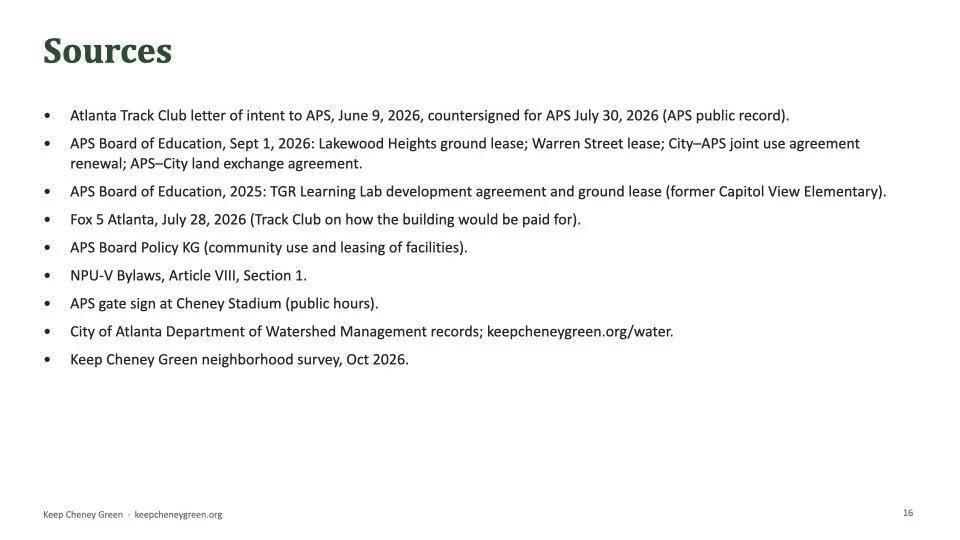
16. Sources. Every figure in this presentation comes from a public document: the Track Club's letter of intent, APS Board items and final leases, APS Board Policy KG, NPU-V's bylaws, City of Atlanta Watershed records, the gate sign at Cheney, and our own survey. Questions or corrections: info@keepcheneygreen.org.
17. More detail. Four backup slides: how APS's other leases compare, the lease terms APS usually requires, what is still to be agreed, and a map of the survey results.
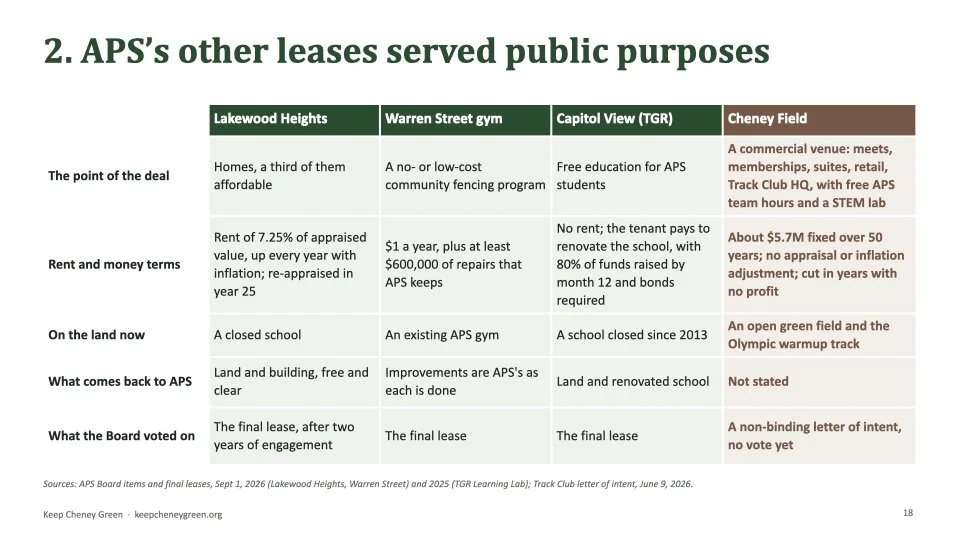
18. APS's other leases served public purposes. Each put a closed school or an APS building to public use: affordable homes, a low-cost community fencing program, free education for APS students. In each, APS gets back what is built. The Track Club would put a commercial venue on open green space neighbors use every day. What comes back to APS after 50 years is not stated. The senior and resident prices now appear in the Track Club's November report, not in the letter of intent or a lease.
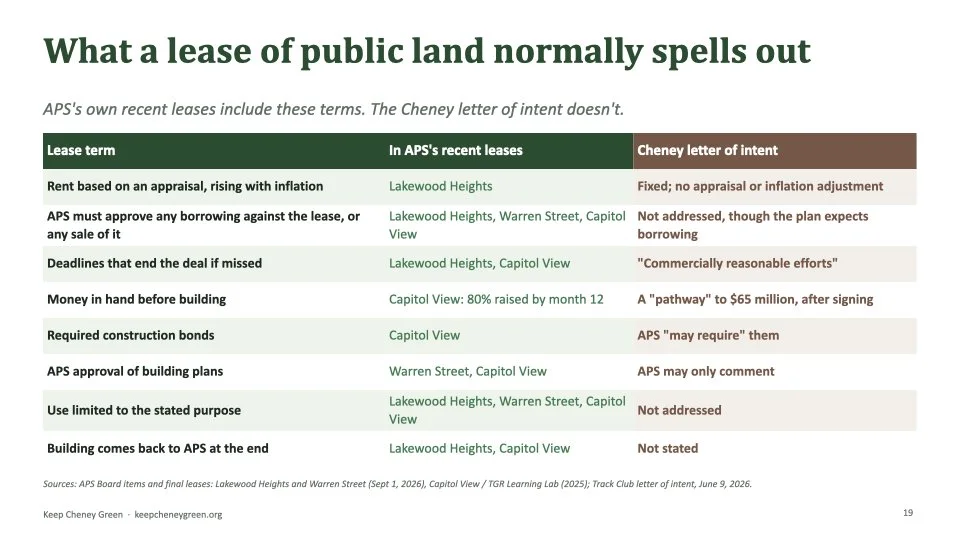
19. What a lease of public land normally spells out. Financing matters most. The Track Club plans to borrow, and in APS's other leases APS must approve any loan secured by the lease, so a lender can never end up controlling public land. The Cheney letter of intent says nothing about it. These aren't exotic protections. APS wrote them into its own recent leases.
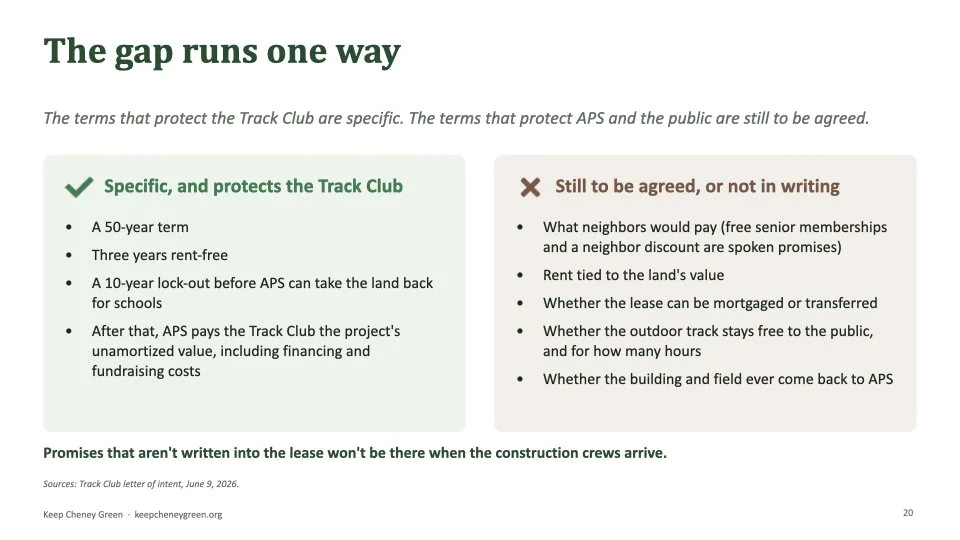
20. The gap runs one way. The terms that protect the Track Club are specific. The terms that protect APS and the public, such as what neighbors would pay, rent tied to the land's value, and whether the lease can be mortgaged, are still to be agreed. This slide was written before the Track Club's November report, which puts free access for Summerhill seniors and youth and a $20-a-month resident price in writing for the first time; they are still not in the letter of intent or a lease. Promises that aren't written into the lease won't be there when the construction crews arrive.
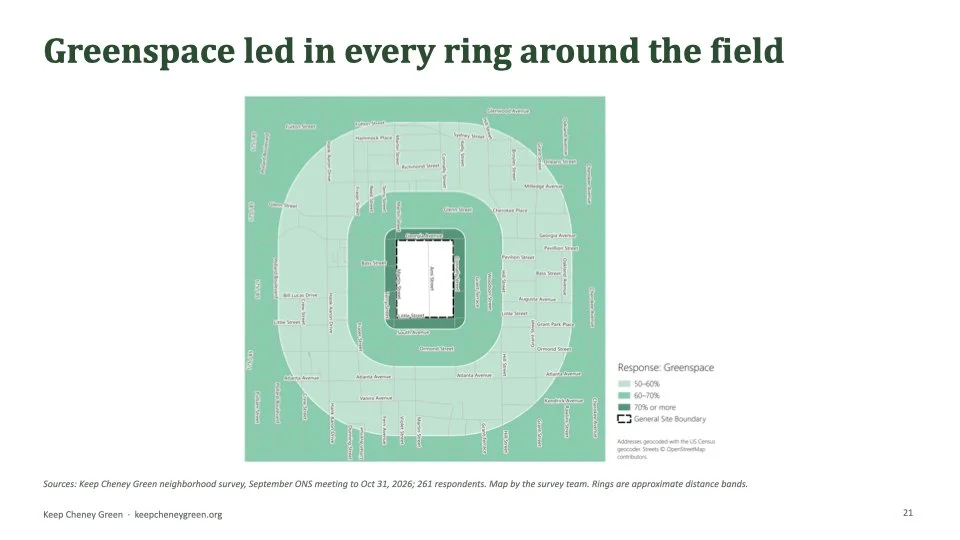
21. Greenspace led in every ring around the field. The map shades the blocks around Cheney by the share of survey respondents who chose greenspace: 70% or more next to the field, 60 to 70% one to two blocks away, 50 to 60% three to five blocks away, and 60 to 70% farther out in Summerhill. How we did the survey, and its limits, is in our mailing-list update of November 5.
Every slide lists its sources. Questions or corrections: info@keepcheneygreen.org.
Since November 2. The Track Club has published its November community report. It sets community prices: free access for Summerhill seniors and youth, and $20 a month for other Summerhill residents. Those prices belong in a lease; today they're in a report, not the letter of intent. The report lists the "APS Board Vote" as its first next step, before its own traffic, parking and stormwater studies, and it doesn't mention NPU-V. Read the Track Club's report
Next: Cheney Field is an information item at NPU-V, Monday, November 9. 7 pm, on Zoom: join the meeting. Sign in with your full name, so you can vote when NPU-V takes up Cheney Field.