Why we love the track but oppose a 175,000-square-foot building on the field
Last updated: October 2, 2026
In brief
We want the Olympic warmup track on the south half of Cheney Field to stay, and we are grateful to the Atlanta Track Club for restoring it.
We oppose the Track Club’s proposal to build a 175,000-square-foot indoor facility on the field. It would cover the open north half that neighbors use every day, the same ground the City once picked for a flood-fighting pond.
Summerhill will keep gaining buildings as it grows. It will not gain new open fields. This is one of the last.
We ask Atlanta Public Schools to keep the north half green, as neighbors asked in 2015, and to make the full plans and their effect on stormwater public before any decision.
We love the track
The outdoor track on the south half of Cheney Field is the surviving warmup track from the 1996 Olympics, built on the site of the old Cheney Stadium. In 2017, the Atlanta Track Club raised $500,000 to resurface it, working with Atlanta Public Schools, and has run programs there ever since under an APS permit. The track is one of the best-used and best-loved places in Summerhill. Runners, walkers, families and student athletes use it throughout the day.
We want all of that to continue. We are not against the Track Club, and we are not against running. The Track Club has been a good steward of the track, and its work with APS student athletes is worth supporting. Our concern is not the track. It is what the Track Club now proposes to build beside it.
What is being proposed
The Atlanta Track Club has submitted a letter of intent to Atlanta Public Schools to build what it calls the Olympic Legacy Track & Field Complex on the Cheney site. According to the Track Club, the building would include “a new 200m indoor track with shared community space, health care offerings, STEM Center, the Track Club’s corporate offices, and an overlook of the existing outdoor 400m track.” The Track Club has put its cost at about $100 million, to be paid for through donations, tax credits and corporate partnerships. It would total about 175,000 square feet, roughly the floor area of three American football fields, most of it a high-ceilinged indoor track hall with a smaller section of up to three stories.
The building would sit on the north half of Cheney Field, the open green space between the track and Georgia Avenue, with its entrance toward Ami Street and vehicle access and drop-off from Georgia Avenue, which the Track Club calls “the active edge.” The Track Club also plans to close Ami Street at its Little Street end, and it has told neighbors it would relocate the two large sewer trunk lines that run beneath the field, a major construction project in its own right whose route has not been made public. After neighbors objected, its revised site plan of August 28, 2026 reduced parking to about 150 spaces, down from 297 in its April plan. On Cheney Field itself, the plan shows the building, with green roof terraces, along with its north, west and south plazas and a pavilion, filling the north half from Georgia Avenue to the track. A narrow trail runs along Connally Street. The plan’s youth soccer field and its parking lot are across Ami Street, on other land. The Atlanta Board of Education is expected to take up the proposal at its meeting on November 2, 2026.
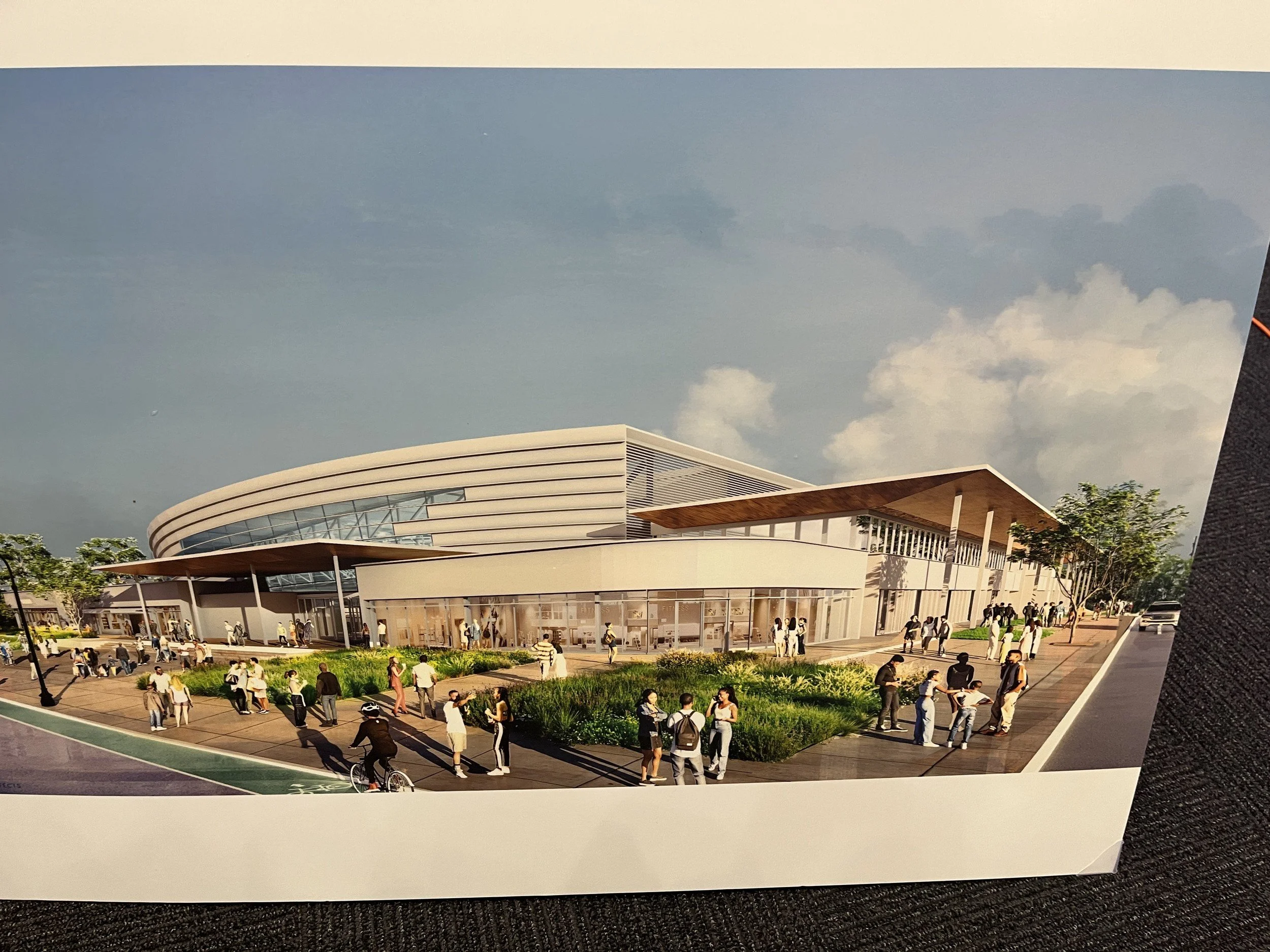
The proposed facility, seen from Georgia Avenue. Rendering: Atlanta Track Club proposal, as displayed at the Track Club’s meeting with adjacent neighbors, September 29, 2026.
The Track Club’s site plan of August 28, 2026. Cheney Field is the long block on the right, between Ami and Connally Streets, with the indoor track facility on its north half and the existing outdoor track to the south. Credit: Atlanta Track Club, Elkus Manfredi Architects and SSOE, published at trackclubatcheney.com.
The Track Club’s figure of 16.47 acres includes the separate former McGill Elementary School site across Ami Street. Our concern is the long Cheney Field itself, about 11 acres between Georgia Avenue and Little Street, Ami Street and Connally Street.
To our knowledge, the building’s height and stormwater design have not been made public.
The terms. Under the Track Club’s letter of intent, which APS signed in July as a non-binding starting point, APS would lease the land to the Track Club for 50 years. The Track Club would pay no rent for the first three years, then $50,000 a year, rising gradually to $150,000 by the lease’s final years, plus a share of its net revenue in profitable years and with reductions in years it loses money. APS could not end the lease to use the land for its own students during the first ten years, and afterward only with two years’ notice and by paying the Track Club for the building’s unrecovered cost. APS running programs would get free hours, and the Track Club offers a health clinic, a STEM lab and local hiring; neighbors would have access through Track Club memberships and day passes. These terms are favorable to the Track Club. Before committing public school land for half a century, the Board should weigh them carefully.
Why the north half should stay open
Neighbors use it every day. The north half of Cheney Field is where Summerhill plays: flag football, pickup games, kids running, dogs and picnics. It is the neighborhood’s de facto park, open to anyone, with no membership and no schedule. In the 2015 Park Pride vision plan, neighbors recorded a “strong desire for ongoing/continued use” of the field.
A building is permanent. A field keeps the future open. Once a 175,000-square-foot building goes up, the field is gone for generations. Summerhill is growing fast, with new homes and apartments, Georgia State’s expanding athletics facilities, and steady redevelopment along Georgia Avenue. All of that growth brings more buildings. None of it brings new open fields. The more the neighborhood grows, the more it will need the one it has.
The City’s own engineers picked this ground for a stormwater pond. Two large sewer trunk lines run beneath Cheney Field toward Atlanta Avenue, where Summerhill and Peoplestown flood, and in 2017 the City’s watershed plan proposed a pond on the north half to slow the water down. A building would add roof and pavement exactly there and take that site off the table for good. It would also mean digging up and moving the trunk lines, down Connally Street, along the tree-lined east edge of the field, or near Ami Street. We do not know which. Read more: “The City’s own plan put a flood-fighting pond on this field.”
The same ground, two plans. Left: the City’s proposed stormwater pond (project IN-9283), outlined in blue on the north half of Cheney Field. Right: the Track Club’s proposed building on that ground. Both maps are shown with north at the top, Georgia Avenue across the top, and Ami Street (left) and Connally Street (right) on either side. Sources: City of Atlanta Department of Watershed Management, Intrenchment and Sugar Watershed Improvement Plan, 2017; Atlanta Track Club, site plan of August 28, 2026.
It would be the first time. Even when the Board of Education began building Cheney Stadium in 1948, over neighbors’ objections, its only building was the bleachers, and well over 90% of the field stayed open. Through the highways, the Braves and the Olympics, the field survived. The proposal would, for the first time in the field’s known history, cover most of it with a building. Read more: “In 1947, neighbors asked for a park here. Here’s what happened.”
Questions we hear
-
The Track Club says it would “offer open green space, running and walking access.” We welcome that commitment, but landscaping around a large building is not the same as an open field. The published rendering shows planting beds along a plaza, and on Cheney Field itself the latest site plan leaves only narrow strips of green around the building and its plazas. The new green space and youth soccer field it shows are across Ami Street, on other land. A neighbor cannot play a pickup game, throw a football or let kids run free on that. What would be lost is the field itself.
-
New development must manage the first inch of rain that falls on its site, well short of the 1.8-inch standard the One Water plan recommends for this watershed. Meeting code is not the same as keeping a field. More on our water page.
-
The Track Club’s work with APS athletes deserves support, and the outdoor track will keep serving them. Our question is not whether an indoor facility could do good. It is whether it belongs on the last large open field in the neighborhood, on top of the City’s trunk lines, on ground the City has marked for stormwater relief.
The neighborhood already has two outdoor tracks, at Cheney Field and King Middle School, and the YMCAs at the Villages at Carver and East Lake both have indoor tracks. What Summerhill lacks is not another track. It is space built around its own needs.
-
Summerhill does need more indoor space, and we take that seriously. Neighbors have asked for pre-K space, a library and places to meet. In the 2015 plan, they also asked for classes such as tai chi, programs for kids, programs with King Middle School teens, a workshop for kids and teens, and a place for the neighborhood to gather. Under the letter of intent, the Track Club would offer meeting space “as mutually agreed upon,” a health clinic partnership and a STEM lab, inside a building planned mainly around an indoor track and the Track Club’s headquarters. Neighbors would use the facility through Track Club memberships.
There is already a natural home for Summerhill’s indoor needs. The City’s Georgia-Hill Neighborhood Center, at 250 Georgia Avenue across from King Middle School, hosted nearly every meeting of the 2015 plan, and neighbors called it “the bridge between neighborhoods.” It housed a public library until 2016 and today houses organizations that serve residents, including a preschool. Renewing Georgia-Hill, and building on land in the neighborhood that has been built on before, could meet these needs without giving up the field.
-
Keep the track. Keep the north half green, in the spirit of the neighborhood’s 2015 vision plan: natural-grass fields, including room for soccer, open lawn, shade, and green infrastructure that soaks up rain. We are surveying neighbors now about what they would most like to see, and we will share the results here.
A growing neighborhood will need new buildings, too. They belong on land that has been built on before, not on the field that never has been, and not given over to surface parking. Cheney Field also matters to the whole watershed: the City’s trunk lines run beneath it, and its open ground lets rain soak in upstream of the streets that flood. In 2015, neighbors asked for event parking that would not overwhelm “the community with even more large surface lots.” And APS should keep its land free for the students of the future.
What we ask
We ask Atlanta Public Schools, the Board of Education and the City to keep the track, keep the north half of Cheney Field green, and make the full proposal public before any decision. See our full requests, and how you can help.
More about Cheney Field
Sources: Atlanta Track Club, Olympic Legacy Track & Field Complex at Cheney (trackclubatcheney.com), Overview and The Project pages, and site plan of August 28, 2026; Atlanta Track Club letter of intent to Atlanta Public Schools (June 9, 2026; countersigned by APS July 30, 2026) and its April 1, 2026 site concept study; City of Atlanta Department of Watershed Management, Intrenchment and Sugar Watershed Improvement Plan (2017), Table 7-1 and project sheet IN-9283; Intrenchment Creek One Water Management Plan (2020); Park Pride, Parks of Summerhill Vision Plan (2015); Fox 5 Atlanta, “Atlanta Track Club proposes $100M indoor facility at Cheney Stadium” (July 28, 2026); Georgia State University News, “Georgia State Athletics unveils new vision” (March 25, 2026); City of Atlanta, Neighborhood Centers; Patch, “Three Libraries Closing in Preparation for New Southeast Library” (May 20, 2016); YMCA of Metro Atlanta, location pages for the Villages at Carver Family YMCA and East Lake Family YMCA. See also the sources on our water and history pages.