In 2015, neighbors planned a park here. Let’s build on it.
Last updated: October 2, 2026
In brief
In 2015, Summerhill neighbors spent most of a year with Park Pride planning the future of their parks, through nine steering committee meetings, four public meetings and a survey of more than 175 residents. Atlanta Public Schools, the Department of Watershed Management and the Department of Parks and Recreation were all consulted.
The plan they produced treated the north half of Cheney Field as part of an expanded Phoenix II Park, with play space, gathering places and ponds that soak up stormwater.
Eleven years later, to our knowledge, not one new park from that plan has been built in Summerhill. Some of its biggest ideas have already been lost to development.
Summerhill is being branded an “athletics neighborhood.” We love athletics, but our neighborhood is more than that, and its parks should honor who we are.
We ask that the neighborhood’s plan for Cheney Field not be lost too.
Let the plan speak for itself
The Parks of Summerhill Vision Plan was not written by any one group. In Park Pride’s words, “Each year Park Pride solicits applications from Atlanta communities interested in discussing and building consensus around their neighborhood greenspace. The Parks of Summerhill undertook this effort in 2015.”
The flyer inviting neighbors to take part explained why the moment mattered: “This year, due to flooding, the City of Atlanta will be installing two massive underground stormwater vaults near Phoenix II Park… Coupled with the Braves move, this presents a once in a lifetime opportunity to re-imagine your parks and greenspaces.”
The concerns neighbors brought to that process will sound familiar today. The plan lists “widespread and persistent flooding in the neighborhood,” the City’s planned “combined sewer vault under Cheney Field,” and among Atlanta Public Schools’ proposals, the “potential renovation of Cheney Stadium.” At the very first public meeting, neighbors named APS ownership of “key greenspaces” as one of the neighborhood’s challenges.
The plan described the field plainly: “The Cheney Stadium site is used like a public park with a public track and an open field. It attracts significant use.”
How neighbors made the plan
Park Pride’s process, the plan says, “relies on robust community engagement.” Over 2015, neighbors met nine times as a steering committee and four times in public. They drew on aerial photographs, posted notes on draft plans, and voted with colored dots on what mattered most.
![“Attendees at the second public meeting were encouraged to draw their dreams directly on aerial photos [of] each park.”](https://images.squarespace-cdn.com/content/v1/6ac059bfed28d11a401909bc/9c1732fc-cd17-425f-9c3d-3a5821dd6ffb/Vision_Fig1_Workshop_drawing.jpg)
Figure 1. “Attendees at the second public meeting were encouraged to draw their dreams directly on aerial photos [of] each park.” Credit: Park Pride, Parks of Summerhill Vision Plan, 2015.
The neighborhood’s wish list from that first meeting was full of things no Summerhill park offers, then or now. Two ideas rose to the top and stayed there:
Parks as sponges. “Visioning participants and the Parks of Summerhill Steering Committee embraced the concept of using parks as sponges, filtering, infiltrating and reducing volumes of stormwater runoff from the neighborhood into combined sewers. The idea of using rainwater as a resource rather than as a waste product resonated with many participants.”
Connected parks. “Connectivity emerged as a key priority for the community. Strategies for connecting parks to each other and to other public greenspaces were explored throughout the process.”
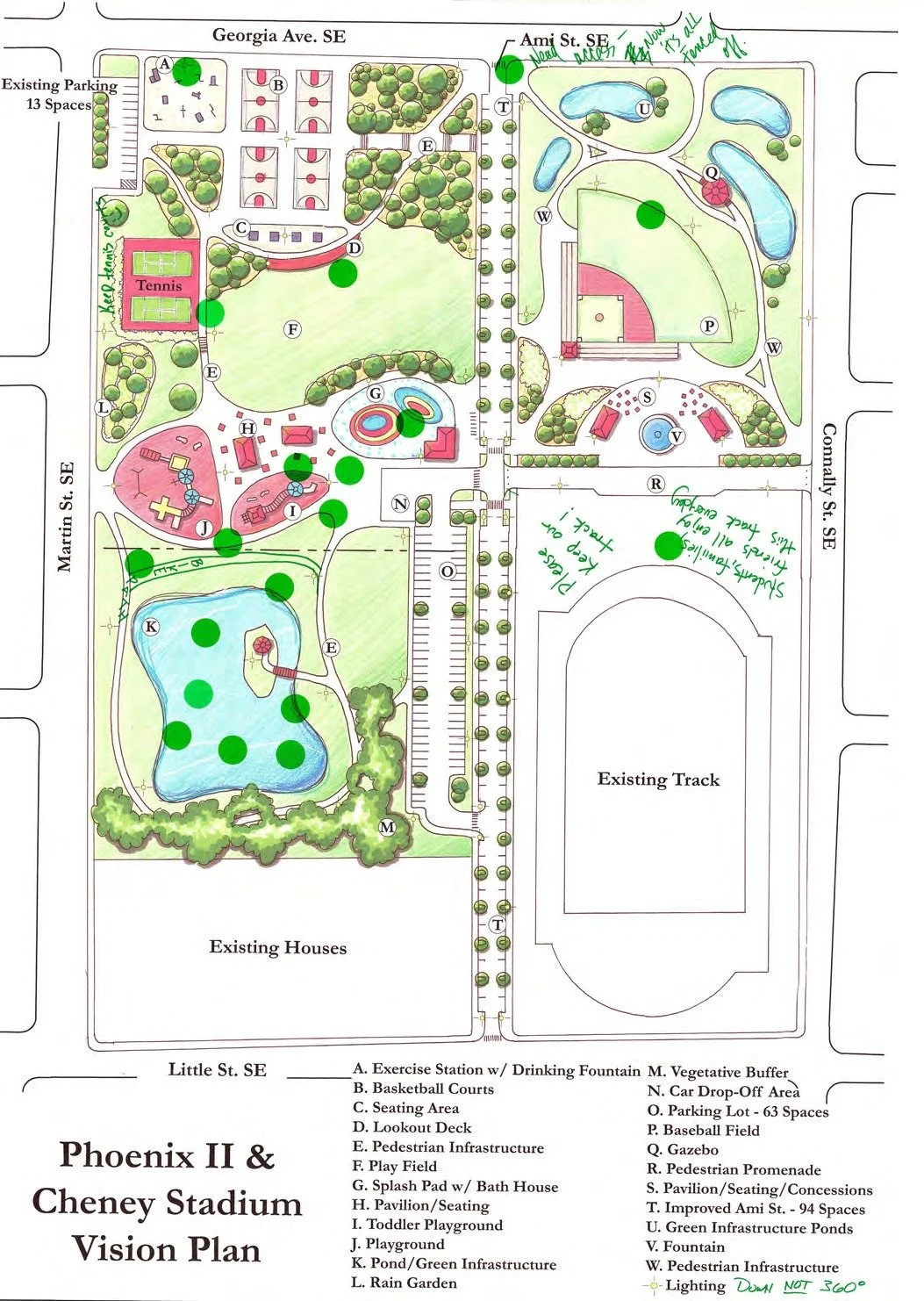
Figure 2. At the final public meeting, neighbors placed green dots on their priorities. “The large pond and enlarged playground were the community’s priorities on the Phoenix II and Cheney Stadium Vision Plan.” Credit: Park Pride, Parks of Summerhill Vision Plan, 2015.
What the plan imagined for Cheney Field
The plan joined Phoenix II Park with the two Atlanta Public Schools parcels beside it: “the northern end of the ‘Cheney Stadium’ site and the former McGill Elementary School site.” Together, it said, “Phoenix II Park is envisioned as the active core of the neighborhood.”
On the north half of Cheney Field, above the existing track, the plan drew stormwater ponds, a ball field, a gazebo, a pavilion and gathering space, a fountain, and a promenade across the field connecting it to Phoenix II Park. It recorded the community’s “strong desire for ongoing/continued use of the Atlanta Public School’s Cheney Field site.” The ball field reflected an APS proposal at the time, and neighbors asked for access to it whenever APS was not using it. Today, we would want neighbors to help decide which fields and sports facilities belong in the new park.
Figure 3. The Phoenix II Park and Cheney Stadium Vision Plan. Cheney Field is on the right, between Ami and Connally Streets, with the existing track at the bottom. Credit: Park Pride, Parks of Summerhill Vision Plan, 2015.
Eleven years later
To our knowledge, no new park has been built in Summerhill since the plan was finished. Many residents assumed the plan was quietly moving forward. Instead, some of its most important ideas have been overtaken.
The plan’s centerpiece for the old Braves parking lots was a park at the site of Hank Aaron’s record-breaking home run. “The community felt strongly that the historic baseline should be renovated into a park, and that the public should have access to the historic site.” That ground is now the site of Georgia State University’s new 1,000-seat baseball stadium, with the home-run marker preserved. The park corridor neighbors wanted through the parking lots has given way to the Carter redevelopment.
Figure 4. The full Summerhill master vision plan, showing the network of connected parks neighbors imagined, much of it on land that has since been redeveloped. Credit: Park Pride, Parks of Summerhill Vision Plan, 2015.
The water plans changed too. The “capacity relief pond” the City proposed in Peoplestown, which neighbors hoped would be a visible green amenity, became a 20-million-gallon underground vault beneath a new park. The vault under Cheney Field was never built. Whether the Peoplestown vault now does the work the Cheney vault was meant to do, and whether it could handle a large new building and its paving upstream, has not, to our knowledge, been publicly answered.
More than an “athletics neighborhood”
Georgia State University now describes its plans for Summerhill as “continued development of an athletics neighborhood in Summerhill,” a “College Town Downtown.” Its list includes a baseball stadium, a softball stadium, a beach volleyball venue, tennis courts, a covered football practice field, and basketball and volleyball practice facilities. The Track Club’s proposal would add an indoor track and headquarters to the same few blocks.
We love athletics. Summerhill has cheered for the Braves, welcomed the world for the 1996 Olympics, and runs on the Cheney track every day. But there is more to the people of Summerhill than that.
There is more history. This is a neighborhood founded by freed men and women in 1865, whose residents asked for a park on this very field in 1947 and, when they were refused, built a community center themselves. Read the story: “In 1947, neighbors asked for a park here.”
There is more concern for our environment. We live on the old channels of Intrenchment Creek, downstream of downtown’s pavement, and we know what happens on our streets when the rain comes. Read more: “The City’s own plan put a flood-fighting pond on this field.”
And there is much more to the rich lives of our neighbors: children who need somewhere to run that isn’t on a schedule, elders who want a shaded bench, families gathering for reunions, and neighbors old and new who simply want to meet one another on common ground. None of that needs a ticket, a membership or a game time.
Summerhill is gaining stadiums, practice facilities and ticketed venues. It has not gained a single new public park. We want our neighborhood to honor who we are and who we have been, rather than conform to a brand. Cheney Field is one of the last places where the neighborhood’s own plan can still come true.
What we hope for now
We want to build on the 2015 plan, not replace it:
Keep the track, and the community’s access to it.
Make the north half of Cheney Field a park, joined with Phoenix II Park as the plan imagined, with natural-grass fields (including room for soccer), open lawn, shade, and places to gather.
Build where buildings have stood before. Keep open what has always been open.
Meet the neighborhood’s indoor needs where they belong. Neighbors have long asked for a library, pre-K space, classes, and places for teens and families to gather. The City’s Georgia-Hill Neighborhood Center, which neighbors in 2015 called “the bridge between neighborhoods,” is a natural home for them.
Let the park work as a sponge, with ponds, rain gardens or other green infrastructure on the ground the City itself once chose for a stormwater pond.
Ask the neighborhood again. Our survey of neighbors is under way, and its results will update the 2015 plan for today’s Summerhill.
Where we go from here
APS owns Cheney Field, and any path to a park runs through APS and the City. APS has opened school land to the public as park space before, and there are several ways it could happen here. Read more: “How a park can happen, and how you can help.”
If you agree that the neighborhood’s plan deserves to be honored, join us.
More about Cheney Field
Sources: Park Pride, Parks of Summerhill Vision Plan (December 2015); Park Pride, “A Greenspace Vision for Summerhill”; Fox 5 Atlanta, “Georgia State University preps construction of new baseball stadium” (December 12, 2025); Georgia State University News, “Georgia State Athletics unveils new vision” (March 25, 2026); Georgia State University Magazine, “Summerhill’s Next Act” (Fall 2019); Canopy Atlanta and Capital B Atlanta, on the Peoplestown sewage project (January 27, 2026). See also the sources on our water and history pages.